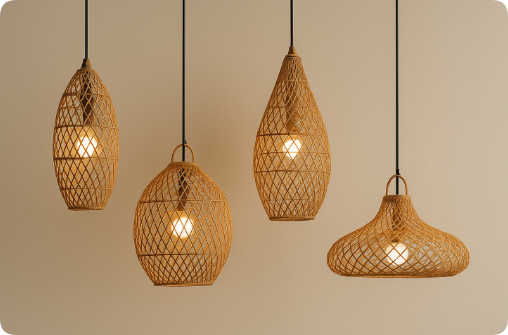
For more ideas on creating a refined interior with natural lighting, see how woven rattan lighting can elevate a dining area, explore natural home lighting ideas for a more expensive-looking interior, and discover living room pendant fixture ideas.
Eco-Friendly Lamp Shade Ideas for a More Expensive-Looking Interior
Sustainable woven lighting can improve an interior in two important ways. It introduces natural texture that makes a room feel more layered, and it provides soft illumination that reduces the cold appearance of hard modern surfaces.
A premium result depends on more than the use of plant-based fibers. The shade must be well proportioned, securely constructed, visually balanced, and suitable for the environment in which it will be installed.
1. Evaluate the Natural Material
Review the fiber quality
Rattan and bamboo should feel stable, properly dried, and appropriate for the intended weaving pattern. Weak, brittle, or poorly prepared fibers may split, distort, or change shape during transportation and long-term use.
A carefully made shade should preserve the natural appearance of the material without looking unfinished. Slight variations in tone can communicate craftsmanship, but excessive discoloration or irregular construction may reduce the premium effect.
Examine the internal structure
The woven exterior is only one part of the fixture. The internal frame, bulb holder, suspension cable, ceiling canopy, and connection points must also be reliable.
A natural shade placed around unsuitable electrical components will not provide a high-quality result. The decorative and technical parts should be designed as one complete fixture.
Consider durability and maintenance
Natural fibers require regular dust removal and protection from prolonged moisture. A soft brush, microfiber cloth, or low-suction vacuum attachment is generally suitable for routine cleaning.
The shade should also be accessible after installation. Fixtures placed in high ceilings, hotel lobbies, or large restaurants need a realistic maintenance plan.
2. Match the Shade to the Room
Dining areas
A Dining Room Ceiling Light should relate to the dimensions of the table beneath it. A fixture that is too small may look temporary, while one that is too large can obstruct views and make the seating area uncomfortable.
A broad woven form can create intimacy and visually complete the dining arrangement. Warm illumination also helps timber, tableware, and food appear more inviting.
Living rooms
A Living Room Pendant Fixture can define the main seating area and create a stronger connection between the ceiling, sofa, rug, and coffee table.
The lamp should be positioned in relation to the furniture zone rather than automatically centered within the entire room. This is especially important in open-plan interiors.
Whole-home coordination
Well-planned Natural Home Lighting should use related materials and color temperatures without repeating the same fixture in every room.
A coordinated home may combine one large statement lamp, several compact pendants, and quieter wall or floor lights. The common connection can come from the natural material, warm tone, or handcrafted character.
3. Create a More Expensive-Looking Atmosphere
Use controlled bohemian influence
Modern Boho Lighting looks most refined when woven texture is combined with clean furniture lines and a restrained palette.
Warm white, cream, sand, muted green, charcoal, and natural timber create a sophisticated foundation. One dominant woven fixture will usually look more intentional than many competing decorative objects.
Balance natural and polished surfaces
Rattan and bamboo create attractive contrast with stone, glass, brushed metal, smooth plaster, and painted cabinetry.
This difference between organic texture and refined surfaces makes an interior feel deeper and more carefully designed. Repeating the natural tone in one or two accessories is usually enough to connect the fixture with the room.
Improve the light quality
Warm-white LED bulbs enhance the golden color of woven fibers. Frosted bulbs reduce direct glare when the weaving is open, while dimmer controls allow the room to adapt to dining, entertaining, reading, and relaxation.
A decorative fixture should not be expected to provide every type of illumination. Wall lights, table lamps, floor lamps, and concealed lighting can support the main woven shade.
4. Develop Customized Woven Fixtures
Adapt the design to the architecture
A Custom Rattan Pendant Light Manufacturer can modify the diameter, depth, weaving pattern, finish, suspension length, frame, canopy, and electrical configuration.
Custom proportions are especially valuable for long tables, double-height ceilings, stairwells, villas, hotel lobbies, and restaurant interiors where standard retail sizes may not provide enough visual impact.
Coordinate branded production
An OEM Rattan Lighting Factory China can manufacture products according to approved drawings, private labels, packaging requirements, electrical specifications, and quality-control standards.
An ODM Decorative Lighting Supplier may offer existing designs that can be adjusted for a particular market, retail collection, interior concept, or customer group.
Prepare wholesale programs
A Wholesale Wicker Pendant Lamp program can support importers, retailers, furniture brands, lighting distributors, interior designers, and project buyers.
Before approving a production order, review physical samples, dimensions, material consistency, electrical components, mounting systems, carton protection, installation instructions, and replacement parts.
5. Apply Natural Lighting to Hospitality Projects
Hotels
A dependable Hospitality Lighting Manufacturer should understand guest comfort, durability, cleaning access, electrical requirements, and visual consistency.
A Hotel Project Lighting Supplier may coordinate fixtures across guest rooms, restaurants, reception areas, corridors, lounges, suites, and public spaces.
The designs should feel connected without making every zone appear identical.
Resorts
A Resort Decorative Lighting Factory can develop oversized woven forms for villas, bars, restaurants, lobbies, reception areas, and covered leisure spaces.
Natural fibers work especially well with timber architecture, stone floors, tropical landscaping, linen upholstery, and open-plan environments.
Restaurants and experience-focused spaces
An Artisan eco-friendly Handmade Boho restaurant woven natural rattan bamboo light can become a recognizable part of a venue’s identity.
Guests may not analyze the weaving technique, but they often remember whether the space felt warm, intimate, comfortable, and visually distinctive.
The fixture must also support menu visibility, circulation, table lighting, cleaning, and long-term maintenance.
6. Manage Commercial and Contract Requirements
Coordinate the complete specification
A Contract Lighting Solutions Provider can support drawings, sampling, material approval, electrical documentation, customization, production schedules, packing, and phased delivery.
Clear specifications reduce the risk of inconsistent finishes, incorrect cable lengths, unsuitable mounting systems, and installation delays.
Confirm commercial suitability
A Commercial Pendant Light Supplier should consider ceiling structure, suspension height, fixture spacing, maintenance access, replacement components, and the electrical requirements of the destination market.
Commercial fixtures may be used for longer periods than residential lamps, so durability and serviceability should be evaluated carefully.
Control large-volume consistency
A Bulk Order Rattan Lighting Manufacturer should maintain consistent shade dimensions, weaving, natural color range, hardware, packaging, and workmanship throughout the production run.
Approved samples, inspection standards, and clear tolerances are particularly important when many matching fixtures will be installed within one property.
7. Make Sustainability Part of the Premium Design
An environmentally conscious fixture should not depend only on a natural appearance. Buyers should consider material sourcing, product lifespan, repairability, packaging, replaceable electrical parts, and transportation efficiency.
A durable lamp that remains useful for many years may provide greater long-term value than a poorly constructed product made from natural fibers.
The most sophisticated interiors combine responsible material choices with dependable engineering, comfortable illumination, and disciplined styling.
A woven shade looks more expensive when its scale suits the room, its structure feels secure, its light is comfortable, and its material relates clearly to the surrounding architecture and furniture.
Final Selection Checklist
Room dimensions and ceiling height
Furniture placement and fixture scale
Fiber type and weaving quality
Internal frame construction
Bulb visibility and required brightness
Suspension length and ceiling canopy
Electrical compatibility
Cleaning and maintenance access
Packaging and transportation protection
Replacement component availability
The final fixture should remain attractive during daylight, when switched off, and when illuminated at night.
A well-designed natural woven lamp can make a modest interior feel more considered and a premium interior feel warmer, more personal, and more memorable.
Address
No. 3, Lane 6, Fushan, Tiebian Village, Henglan, Zhongshan City


CONTACT US
_lutHu5.png)


Call Us
13527147288
E-mail Us